 Willow Aliento
 Mark Vender
The Kigali climb – Managing risk in Australia’s ongoing refrigerant transition
The 10-year milestone of the Kigali Amendment is a fitting moment to reflect on the HFC phase-down journey so far – and what lies ahead. For Australia, this means re-examining key policy settings and industry practices relating to refrigerants with high global warming potential (GWP) to ensure early progress is matched by future successes.

Australia moved early to address the climate risks of high-GWP refrigerants. At the Commonwealth government level, the late Patrick McInerney co-chaired the Montreal Protocol negotiations that led to the 2016 Kigali Amendment to phase down HFCs. In 2018, one year ahead of the Kigali Amendment officially coming into force globally, Australia introduced bulk import quotas for HFCs that could be tightened over time to achieve the target of an 85% reduction by 2036, based on average HFC imports and 75% of average HCFC imports for the period of 2011–2013. As Figure 1 shows, Australia’s domestic HFC phase-down was also set at 25% lower than the baseline required under the Montreal Protocol.
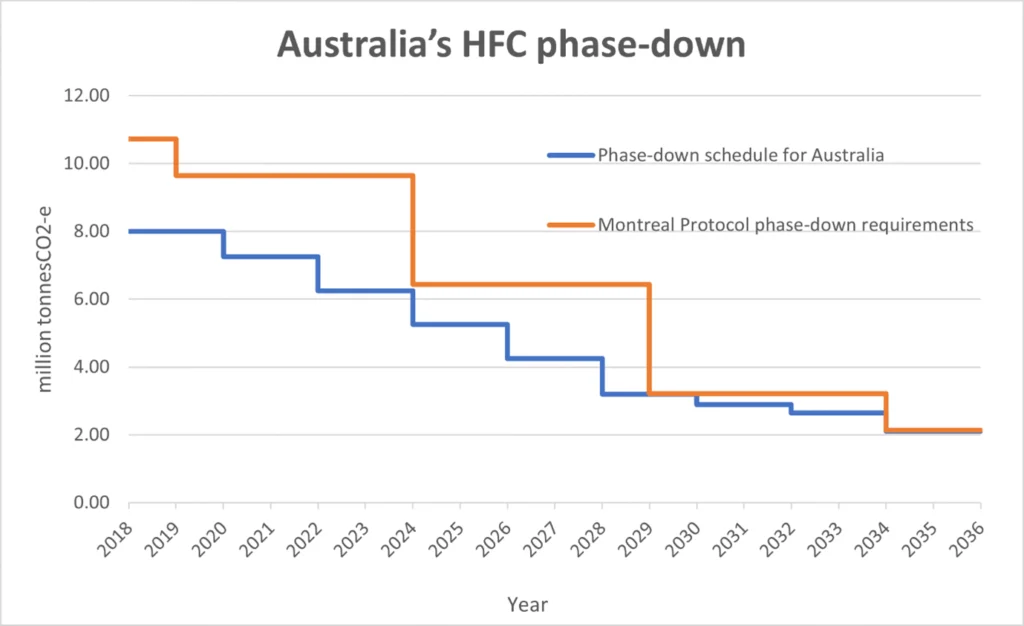
Figure 1: Australia’s HFC phase-down schedule against Montreal Protocol phase-down requirements. Source: DCCEEW
As a result, over the past decade, Australia has consumed smaller volumes of HFCs than Montreal Protocol obligations permit, while still addressing industry requirements in the refrigeration and air conditioning sector.
“We got off to a really good start,” says Peter Brodribb, Managing Director of Expert Group, a consulting firm which has been researching Australia’s refrigerant bank and usage for the past two decades.
“Australia decided that we could choose an accelerated phase-down relative to the Kigali Amendment. At the time that made a lot of sense because we had a bit of a head start in 2017.”
Brodribb notes the HFC phase-down was well supported by established schemes for product stewardship and technician licensing.
“One thing that Australia has historically and still continues to do really well, relative to (some) other countries, is we do have a very good refrigerant reclaim program.”
Refrigerant Reclaim Australia (RRA) operates the nationally authorised product stewardship scheme for refrigerants, through which refrigerants are recovered and destroyed at end of life. It is funded by industry, through levies on imported refrigerant.
Each year, about 500 tonnes of refrigerant are destroyed through the RRA scheme. Though there is undoubtedly room for improvement (and the scheme is currently undertaking a review), Brodribb estimates that 2,500 tonnes of refrigerant are retired annually, putting Australia’s recovery and destruction rate at about 20%.
(Recent) Chair of the Australian Refrigeration Council, Dr Greg Picker, notes this figure does not include reclamation or recycling which is likely to be (combined) larger than the destruction amount.
“So somewhere around 40 to 50% of refrigerant may be recovered,” Dr Picker says.
Another positive is Australia’s licensing scheme for refrigerants, according to Brodribb.
The Australian Refrigeration Council administers the national scheme, issuing licenses for refrigerant handling and trading. This supports responsible management of scheduled substances such as HFCs and HCFCs in Australia’s HVAC&R systems.
AIRAH CEO, Sami Zheng, Affil.AIRAH, says detailed information about Australia’s refrigerant bank and usage also helped with the phase-down.
“Thanks to the work of Expert Group on the Cold Hard Facts series of reports, with support from the Commonwealth government, Australia has longitudinal data over the past two decades that can tell us how we are tracking and where issues might arise,” she says.
“This is especially important as we enter a more challenging phase of our refrigerant transition.”
Obstacles emerge
When Australia’s HFC phase-down was first implemented, it was envisaged that the quota systems would reduce imports of bulk high-GWP HFCs and that this, coupled with the development and adoption of new technologies as part of the refrigerant transition in larger developed economies, would lead to reduced imports of equipment reliant on these refrigerants.
But parts of the market did not respond in this way. One of reasons was stockpiling of high-GWP refrigerant.
“Most of the bulk importers brought in two-and-a-half times the typical stock,” says Brodribb.
Dr Paul Taylor, Director, Atmospheric Chemicals Policy, Department of Climate Change, Energy, the Environment and Water (DCCEEW) also pinpoints stockpiling as an issue.
“It ensured a steady supply of these refrigerants and obscured the price signals that the phase-down would otherwise have provided,” Dr Taylor says.
According to Zheng, market forces and a lack of awareness about the phase-down saw end-users in some sectors opting for the lowest first-cost solution, rather than considering the availability of refrigerant and related costs in the medium and long term. She points to the continued use of R404A in commercial refrigeration applications as a clear example.
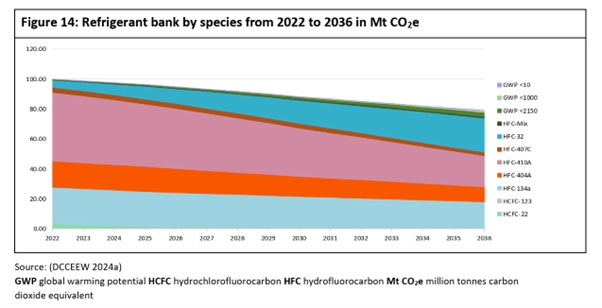
The graph below from Cold Hard Facts 4 shows the stubborn presence of high-GWP refrigerants such as R404A, R410A and R134a, related to commercial refrigeration, larger and packaged air conditioning systems, and mobile air conditioning respectively.
Another factor affecting Australia’s HFC phase-down has been the treatment of refrigerants in pre-charged equipment. The HFC phase-down only covers bulk gas in cylinders; it does not cover HFC imported in pre-charged equipment, as under the Montreal Protocol the refrigerant in this equipment is counted in the country where the equipment is charged.
According to the latest edition of Cold Hard Facts, approximately 3,712 tonnes of HFCs contained in more than 3.2 million pieces of pre-charged equipment (including 254 tonnes in devices such as aerosols, consumer goods, fire protection and scientific or electrical equipment and switchgear) were imported into Australia in 2022. Meanwhile, 2,913.3 tonnes of HFCs were imported as bulk gas. Based on these figures, 56% of refrigerant is arriving in pre-charged equipment, sitting outside Australia’s HFC quota system.
“In some sectors, there has been continued importation of pre-charged equipment containing high GWP refrigerants,” says Dr Taylor. “As a result, businesses and consumers have continued to purchase new equipment that uses these gases, locking in ongoing demand and emissions.”
Zheng points to VRF systems containing R410A (GWP 2,088) and notes that a large proportion of vehicles imported into Australia still contain R134a (GWP 1,430).
Dr Picker observes that Australia imports a significant proportion of pre-charged equipment from countries in Asia that are on a slower phase-down schedule.
“Our mistake was not putting in GWP limits like much of the rest of the developed world did.”
He acknowledges that at the time, Australia’s government and industry stakeholders had good reasons to think this was unnecessary. For example, the experience with CFCs and HCFCs was that transition without regulation can occur.
Meanwhile, other forces are driving demand for refrigerant-based heating and cooling equipment. To achieve the Paris commitment of net zero by 2050, there is a major push for switching gas-burning boilers and heating systems to retrofitted electric alternatives across Australia’s building stock. Refrigerant-based heat pumps are one of the key enabling technologies.
“Climate change impacts are also escalating, including longer, stronger and more frequent heatwaves,” says Zheng. “This is driving increased demand for space cooling in the residential space and in settings including education and recreational facilities.”
Although a shift has occurred as a result of the HFC phase-down (Cold Hard Facts 4 confirms, for example, the rapid shift from R410A to R32 in the early 2020s in the small split stationary air conditioning segment), Dr Taylor says many are concerned that it has not progressed rapidly enough.
“This risks demand for HFC for servicing and charging newly installed equipment in some sectors outstripping supply, drastically increasing HFC refrigerant prices and associated costs to businesses and consumers,” he says.
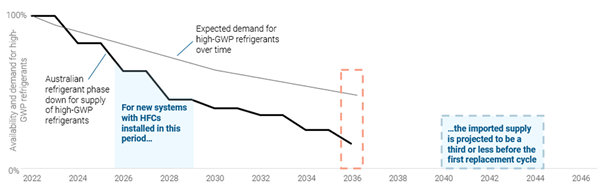
Figure 3: Graph from the Freeze Frame discussion paper showing the looming shortfall in supply.
Brodribb agrees that Australia is consuming refrigerant beyond its means, with wide-reaching and serious implications.
“We’re in a situation where our capped quota plus some reclamation is not enough to service the bank based on the existing stock of equipment,” he says. “I believe that we’re going to run into a really tight situation, to the point where certain sectors are going to miss out. There’s potential that some businesses will suffer more pain than others. It will mostly be the small to medium enterprises that that won’t be ready for this, and that would be a real tragedy.”
Adjusting our approach
A challenge for Australia has been introducing timely restrictions on particular product classes and refrigerants. Although a ban was introduced on certain small air conditioning equipment (charge size of 2.6kg or less) using refrigerant with a GWP over 750, other proposed restrictions on commercial refrigeration equipment have not been implemented.
The pressing need for restrictions across a range of products and refrigerants has led the Commonwealth government to consider other approaches.
“The Ozone Protection and Synthetic Greenhouse Gas Management Act 1989 (the OPSGGM Act) is the primary legislative mechanism for regulating substances listed on the Montreal Protocol (including those added by the Kigali Amendment) in Australia,” says Dr Taylor.
“However, these refrigerants have also been subject to regulation as industrial chemicals in Australia since 1990. As industrial chemicals, there is an option to set nationally consistent environmental management standards under the Industrial Chemicals Environmental Management Standard (IChEMS).”
According to Dr Taylor, setting standards for HFC under the IChEMS has been identified as the best way to deliver the desired set of regulatory changes in a timely manner. Through the IChEMS policy process, measures are assigned for around 1,000 industrial chemicals each year. Conversely, changes to the OPSGGM Act can take many months or years. Measures can also be extended to non-HFC refrigerants. Currently the OPSGGM Act only deals with “scheduled substances” such as HFCs and HCFCs.
“Australia is a small market at the tail end of the world. We cannot drive change in technology, but we can be early adopters if the policy settings are well tuned,” Dr Picker says.
“We need GWP limits on technology to drive change.”
Raising awareness about the phase-down has also been identified as a high priority.
There is a need to educate stakeholders, particularly those on the demand side. In late 2025, the Green Building Council of Australia and AIRAH released a discussion paper titled Freeze Frame: Refrigerants as long-term building infrastructure. The project team spoke to building owners, design teams, HVAC and refrigeration professionals and suppliers to ask how ready they are for a future shaped by refrigerant transition.
The paper notes that many consumers have low awareness of the consequences of the HFC phase-down, what it could mean for the ongoing service of existing installations and how they could avoid risks of continuing to install HFC equipment.
As a result of the discussion paper, work is now commencing on more detailed practical guides for equipment selection.
Another barrier that has been identified is a workforce unfamiliar with new technologies.
“Understanding the need to transition is only one part of the equation,” says Dr Taylor. “Transitioning away from HFC refrigerants also requires confidence in alternatives. Here, training plays a similar critical role in facilitating uptake of alternatives to HFC refrigerants. It is crucial that the workforce installing and maintaining equipment using new technologies or retrofitting existing equipment (where supported by manufacturers and refrigeration engineers) has the skills and capability to undertake this work.”
The Australian Government has supported updates to relevant nationally recognised training packages to ensure newly qualified technicians have received appropriate training.
Zheng says industry has a key role to play in education and training the workforce.
She points to the recent release of an updated Flammable Refrigerant Safety Guide, which aims to improve awareness of how to best manage the health and safety risks associated with the use and management of flammable refrigerants in stationary refrigeration and air conditioning equipment. The project brought together various industry groups to deliver free resources for the workforce.
Other important initiatives are in train. Expert Group has been commissioned to do a rigorous assessment of when the big shortages may occur, with a report expected in the coming months. The Commonwealth government is also focusing more on refrigerants in its Net Zero – Built Environment Sector Plan and Trajectory for Low Energy Buildings.
“For many applications, newer technologies using alternative refrigerants have become mainstream and cost competitive. Investments in new equipment can be coupled with energy efficiency and/or electrification initiatives, with various grants currently available to businesses and consumers across Australia,” Dr Taylor says
As we enter the next crucial phase of the HFC phase-down and the broader refrigerant transition, it is important to recognise both the achievements and the challenges ahead. The experiences in individual countries can be instructive.
“The hard problem is inertia,” Dr Picker says.
“This is all achievable. Industry needs to recognise the issues, and government needs to support with regulation. We know we can do this – we have done this before and there are enough sensible international examples.”
This article was first published in the International Special Issue of the Journal of Centro Studi Galileo and the Renewable Energy Institute.
Main photo: Image by Enrique from Pixabay
PREV
NEXT
Comments
Advertisements

Recent news
- Crooks cook French frozen food aisles
- Beating the heat on high rise sites
- Global reach, local innovation
Latest events
- Adam Morgan shines in Shanghai
- IOR opens nominations for J&E Hall Gold Medal
- Nominations open for IIR scientific prizes
Leave a Reply