 Willow Aliento
HVAC&R turns policy into practice
At ARBS 2026, speakers from across the globe are shining a light on the essential nature of HVAC&R, and its pivotal role in decarbonising the built environment, enabling social progress and protecting human health.
As ARBS 2026 wraps up in Melbourne, one strong message has emerged from keynotes, seminars and panel discussions: our sector is not invisible, it is the engine room where policy turns into practice.
This theme was apparent at the first event, the ARBS Chairman’s Breakfast.
In his address, ARBS Chair, Professor Tony Arnel, highlighted the importance and value of considering “disruption” as a positive force. On the one hand, the current geopolitical events and fossil fuel supply shocks are creating challenges. On the other, the term also applies to those innovators and exemplar projects that are demonstrating new and sustainable ways to address social and economic needs.
This form of disruption is essential, according to Professor Arnel.
A panel featuring Steve Yurek, President and CEO, AHRI (USA), Sandy MacLeod, President and CEO, HRAI (Canada) and Bill McQuade, ASHRAE President (USA), brought the international perspective into the room. The North American organisations face similar challenges to the Australian industry in relation to attracting and retaining skilled talent, navigating cost concerns, and translating the need for decarbonisation and energy demand management into deliverable outcomes.
The growing emphasis on indoor air quality as a metric that needs to be measured, benchmarked and prioritised was also highlighted as the panel spoke to a question from leading public health and indoor air safety advocate, Dr Bronwyn King AO.
This area of practice is one that emerged throughout the entire three-day ARBS seminar agenda and also featured strongly among exhibitors.
Official opening sets the scene
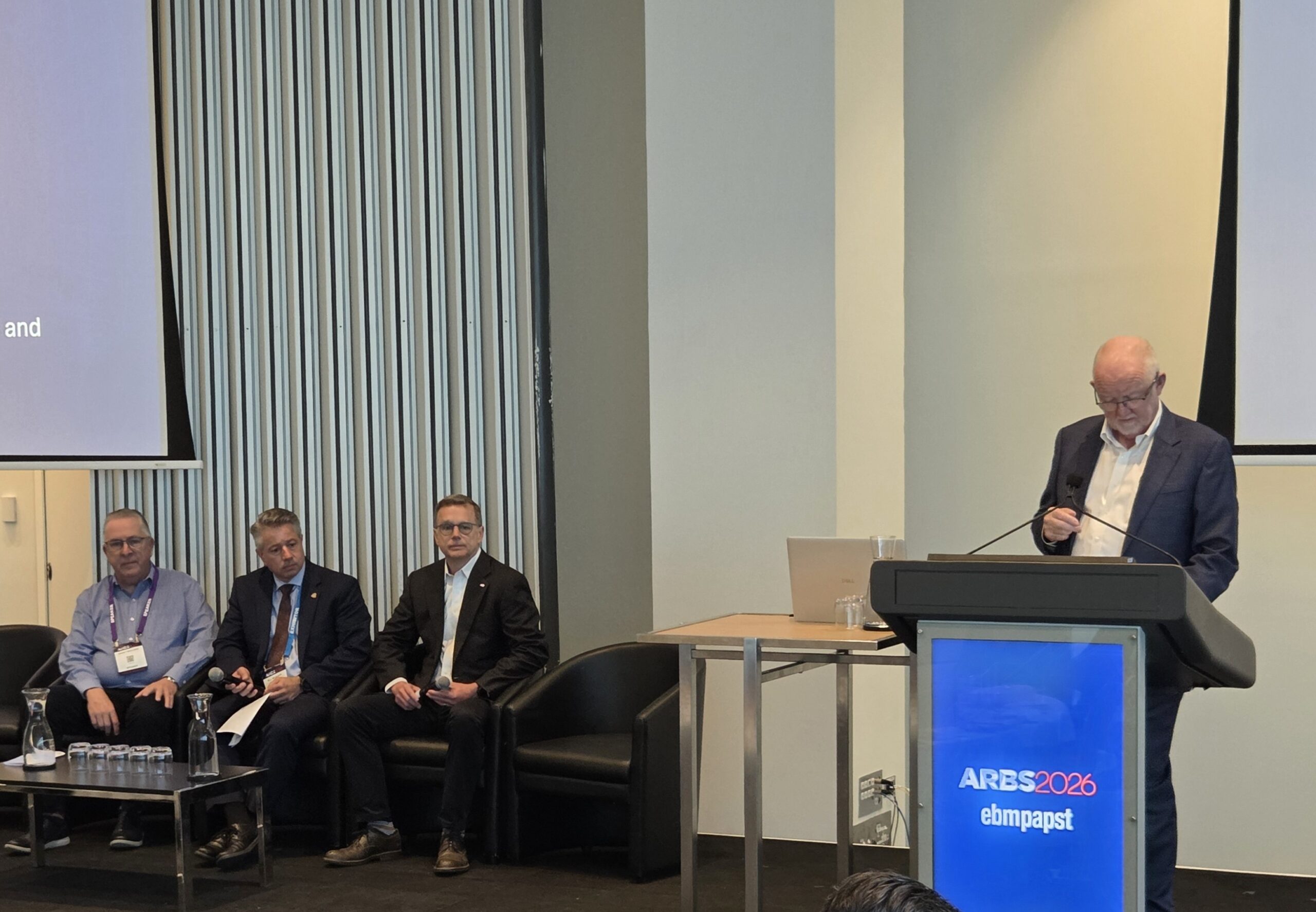
Keynote speaker for the official opening, Melbourne Lord Mayor Nicholas Reece, addressed the data centre boom. He noted the role of the HVAC&R sector and its innovation, and the expertise of HVAC&R engineers, trades and technicians who are enabling design and operational solutions that reduce the strain these facilities place on local energy and water supplies.
Reece also shone a light on the instrumental role of the technical experts in enabling the progress of smart cities. In delivering energy efficiency, electrification and renewable energy transition projects, cities like Melbourne can enact ambitious policies like the city’s zero carbon buildings target.
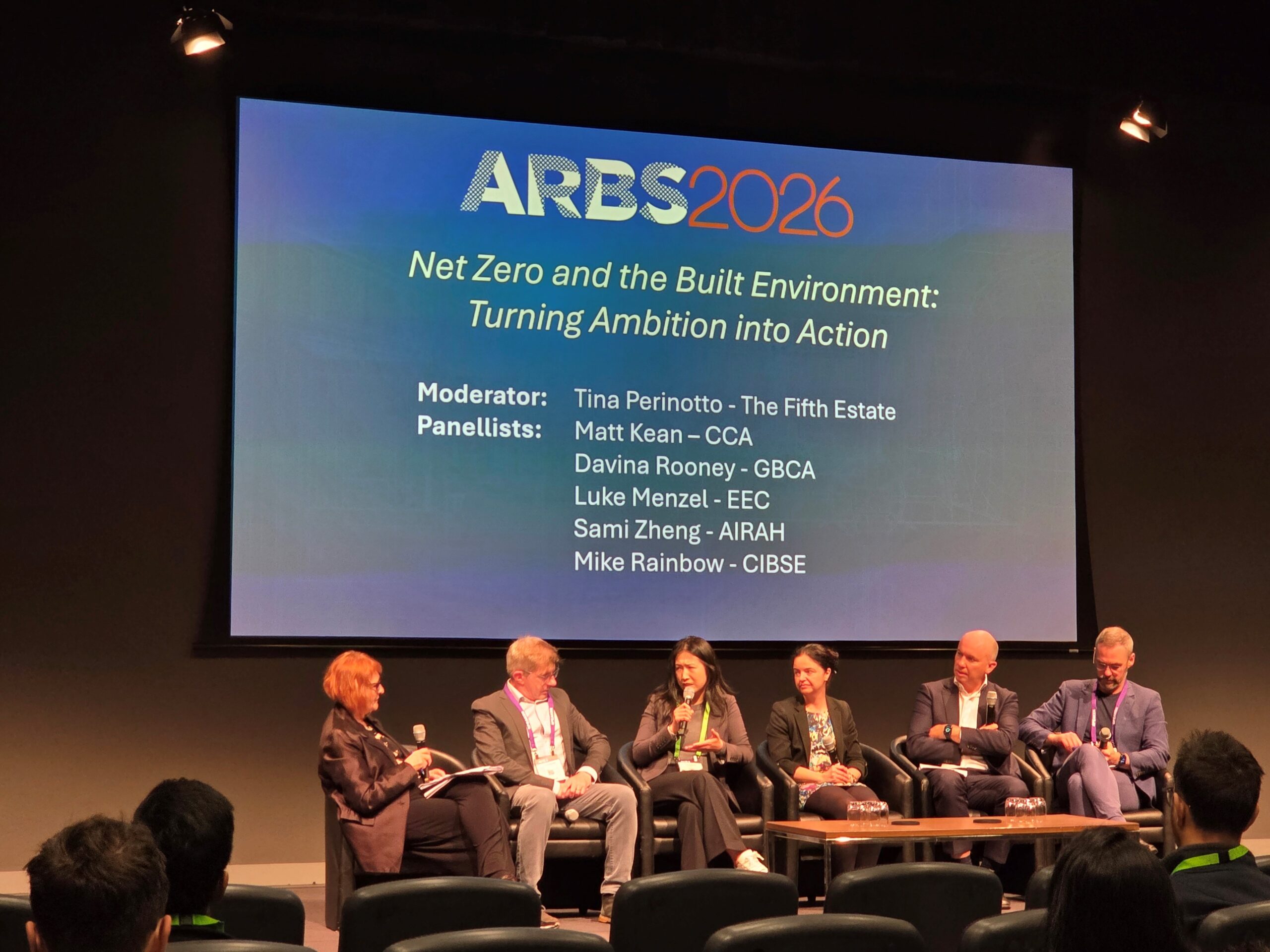
Following the keynote, a panel discussion moderated by The Fifth Estate Managing Editor, Tina Perinotto, tackled the topic, Net zero and the built environment: turning ambition into action.
The panel featured former NSW Government minister, Matt Keane, now Chair of the Climate Change Authority; Green Building Council of Australia CEO, Davina Rooney; CIBSE committee member and chartered engineer, Mike Rainbow; CEO of the Energy Efficiency Council, Luke Menzel; and, AIRAH CEO Sami Zheng.
Keynote Matt Keane began by highlighting that the HVAC&R sector is, along with the rest of the world, experiencing shocks associated with the war in the Middle East.
“What we do plays a role in how we are affected,” he said.
The combination of instability in sourcing fuel energy supplies, disruptions to supply chains and changes in costs are shifting the Australian market to “embrace home grown energy” to a greater extent, Keane said.
“We have the resources, the capital, the capability and increasingly, the technology.”
Matt Keane
Keane noted that the benefits of the transition to renewable, home-grown power “go beyond energy” to include indoor air quality, and improvements to both the health of people and of the planet.
The choices made in relation to HVAC&R design and specifications play a role in the resilience of the entire energy grid, and the entire economy, Keane said.
“We need to go further, and faster with electrification and energy efficiency.”
Energy efficiency as an antidote to geopolitics
Perinotto kicked off the panel discussion off with a question about the impact of the current US leadership and the volatility in the markets resulting from geopolitical events.
Keane said that renewable energy and energy efficiency are a “long term shield” against volatile fuel prices and volatile supply chains.
“We need to get on with the job of electrifying our economy,” he said.
While some voices have called for Australia to double down on drilling for oil and gas, Keane said this approach is “like trying to fix a gambling debt by going down to a casino”.
A question was then put to Davina Rooney about the policies she thinks GBCA members would like to see emerging.
Rooney observed that while buildings can be retrofitted for electrification, it is “really difficult” to do.
The policy shift that needs to occur is all new buildings should be all-electric, she said. There also needs to be unity. Doing reviews on a council-by-council basis is the least productive way to achieve change – we need a national approach.
Rooney said it needs to be understood that investing in efficient, electric buildings up front ensures long-term value.
It’s a matter of, “spend more to get more … that’s why the advocates within this room are so important.”
Luke Menzel noted that part of the challenge in achieving net zero is that while the energy sector itself is heavily regulated, to achieve economy-wide energy efficiency means addressing housing, agriculture, industry, manufacturing and businesses. And there is no consistent state or national regulation that encompasses all those sectors.
“We need real clarity from the states and federal government,” Menzel said.
Currently, only the ACT has provided certainty that there is a time limit on connecting to or relying on a gas network.
At some point in the near future, Menzel said we will also reach a point where emissions reductions within the electricity grid will hit their limit. At that point, the balance of emissions reductions to achieve decarbonisation targets will have to come from businesses and households.
Menzel said it is welcome to see the Commercial Buildings Disclosure Program expanding to other sectors including office tenancies and hotels.
Mike Rainbow noted that in the United Kingdom, minimum energy standards are in place across many types of buildings.
“The rollout of mandatory ratings makes people more invested in energy efficiency,” Rainbow said.
Fulcrum of the net zero transition
Sami Zheng said that HVAC&R is not the “invisible trade” as “we are at the centre of net zero”.
The sector is where the different elements connect of energy use profiles and energy efficiency, she explained. Evidence of the central nature of HVAC&R includes the performance gap between the design intent of a building and the actual operational energy performance, which can differ by 10-20% or even higher.
“We have both financial and environmental incentives to close the gap,” Zheng said.
HVAC&R is also central to electrification, which changes when and how buildings use energy.
“We need systems thinking. We need to reward the right behaviour to reduce peak energy use. HVAC&R should also be grid smart and should integrate with renewables.”
According to Zheng, another crucial aspect of the sector and its contribution include considering refrigerants as long-term building infrastructure that affect lifecycle emissions. Recovery of refrigerants is also important, and a competency uplift in safe handling is vital.
“We have to put people first,” she said.
The role of government is not only in the policy domain. Zheng said that a government pilot that is controlled and demonstrates best practice would be a valuable measure to build up confidence and competence.
Ultimately, the panel concluded that there are considerations around who bears the cost of energy efficiency and the electrification transition. In some cases, it is developers and builders, in other scenarios, it is the owners and occupants.
Zheng said when it comes to the balance between open and capex, it is important to focus on the outcome.
“Net zero is not a promise. It is a practice delivered by people,” she said.
PREV
NEXT
Comments
Advertisements

Recent news
- Seeing all-electric stars in the NABERS Annual Report
- City Facilities Management secures decade-long Coles deal
- Delivering energy wins through cooling innovation
Latest events
- Adam Morgan shines in Shanghai
- IOR opens nominations for J&E Hall Gold Medal
- Nominations open for IIR scientific prizes
Leave a Reply