 Willow Aliento
Global scheme helping laboratories reach net zero
The International Institute for Sustainable Laboratories (I2SL) aims to address a significant gap in resources for lab buildings by developing performance assessment, performance improvement, and professional accreditation tools specific to the energy-intensive laboratory sector.

Laboratories are a unique class of facility, and unlike commercial offices, retail centres or classrooms, there are highly variable operational requirements. For example, a teaching laboratory for high school physics will involve different building services systems and Indoor Environmental Quality (IEQ) specifications compared to a secure laboratory used for medical research involving dangerous pathogens or radioactive isotopes.
This is also partly why existing sustainability tools such as ENERGY STAR and NABERS have not to date developed effective energy efficiency benchmarking approaches for labs. It’s very hard to compare peers in the sector, an issue that I2SL aims to address.
I2SL President, Gordon Sharp, was recently in Australia, and took the time to speak with AIRAH about I2SL’s mission and the release of the latest version of their Laboratory Benchmarking Tool.
Sharp explained that one of the key drivers for developing suitable sustainability approaches is the energy intensity of laboratories.
“Labs use more, much more energy than other types of facilities – five to ten times the energy usage of office buildings, for example,” Sharp explains.
“So, the need to decarbonise labs is quite significant because of their outsized use of energy and obviously emissions.”
Sharp explains that some of the most common energy efficiency measures suggested by energy auditors such as scheduling the operation of air handling units, CO2 sensor-based demand-controlled ventilation and fixing economisers are often not appropriate for controlled environments.
“They process and use enormous amounts of airflow in order to try to keep the lab safe in terms of the chemical emissions that you see in laboratories,” Sharp says.
Other measures such as lighting retrofits, reduced minimum airflow setpoints or duct static setpoint resets also have a “yes, but …” qualifier, according to Sharp. For one thing, they are not the most significant drivers of energy use in a lab.
Bespoke toolkit goes live
The organisation has launched a global program, Labs2Zero, which incorporates both facility-level initiatives and a professional accreditation scheme for lab building professionals.
The overarching goal is to have means for addressing the performance of lab buildings that takes into account their unique and varied systems and requirements.
Development of the program began in 2022, and the goal is to close the gaps in resources for labs by providing methods to evaluate lab facility performance and provide functional pathways for achieving energy savings and emissions reductions.
A facility-level initiative provides a system for benchmarking and ranking facility performance and potential improvements. The Laboratory Benchmarking Tool currently includes a Labs2Zero Energy Score, Labs2Zero Operational Emissions Score and embodied carbon benchmarking.
Complementing this, the Actionable Insights and Measures (AIM) Report is an automated energy auditing software tool that provides facility owners, operators, managers or external consultants a custom dashboard of potential energy saving and cost saving opportunities based on lab-specific attributes.
For individuals, there are two available credentials. The Labs2Zero Champion is already live, and the Labs2Zero Expert will be developed later in 2026.
How to test a lab
I2SL has been working with the US-based Lawrence Berkeley National Laboratory on benchmarking laboratories and has built a database that contains over 1500 labs from around the world. This peer database covers more than 25 million square metres of lab space, all benchmarked for energy, operational parameters, emissions aspects, and climate conditions.
The result is a databank that enables users to compare their own facility against similar facilities across multiple performance indicators using the Lab Benchmarking Tool (LBT).
Around 10–12 basic details of the lab need to be entered to gain a basic snapshot, including energy use index (EUI) and emissions intensity. Scores are presented as a percentile that indicates peer comparison, so a score of 54 means it is better than 54% of the other lab buildings in the database. There is an in-built normalisation process that ensures variations due to function are accounted for, so an energy-intensive facility like a vivarium can be reasonably compared to a teaching laboratory.
“(This) is very important because you might look at a physics building and say, oh, that looks like a great building because it doesn’t use much energy compared to, let’s say, a vivarium,” says Sharp.
“But in reality, that physics building might be very poor in performance, because its peers would typically use less energy than, for example, a vivarium or a chemistry building. So, all this is taken into account in our system, and it then allows you to truly compare like to like, which is very powerful.”
The process is also automated, fast, and free to use. Every user, by inputting their own facility data also adds to the database; so, it continues to evolve and grow the peer cohort and the utility of the datasets.
“You can slice and dice our database and look at different aspects,” says Sharp.
“So, you can create a group of like peers and then see how you compare in certain different performance measures against yourself and those peers.”
Defining “sustainable” for new builds
There is also what is being termed a “target setter”, which is a reverse scoring approach that can be used to help design and development teams in the planning and specifications for new facilities.
“Many times, users (such as) a research organization, a university or a pharmaceutical will go to the designers and say, hey, we want a very sustainable building,” says Sharp.
He explains the conversation often looks like this:
Client: We want a sustainable lab.
Designers: Well, great, how sustainable do you want it?
Client: It’s like, well, we want it real sustainable.
Designers: Well, what do you mean by ‘real sustainable’?
Client: Well, real sustainable.
“So, it’s very hard to quantify sometimes this aspect of sustainability,” concludes Sharp. “These scores provide a very simple and very quantitative way to do that.”
Clients can use the LBT Energy Score Target Setter as a yardstick and go to a design team or development team and ask for a building that is in the 80th percentile or 90th percentile, and the tool will display the energy performance required to meet that goal.
It’s similar to the concept of a target NABERS Score or target ENERGY STAR rating being embedded into commercial office tower planning and delivery.
“We’re trying to provide some very quantifiable ways for people to specify performance, both for new buildings that they’re designing as well as obviously to understand what their existing building portfolio looks like,” says Sharp.
How do people use the scores?
The scoring is proving valuable for a range of stakeholders, including owners of lab facilities or specialist real estate portfolios needing data for sustainability reporting, consultants producing audits and asset owners looking for ways to trim costs and improve facility performance.
A second level of the benchmarking and audit platform has been released, which produces reporting and analysis that can be used to develop the business case for asset improvements.
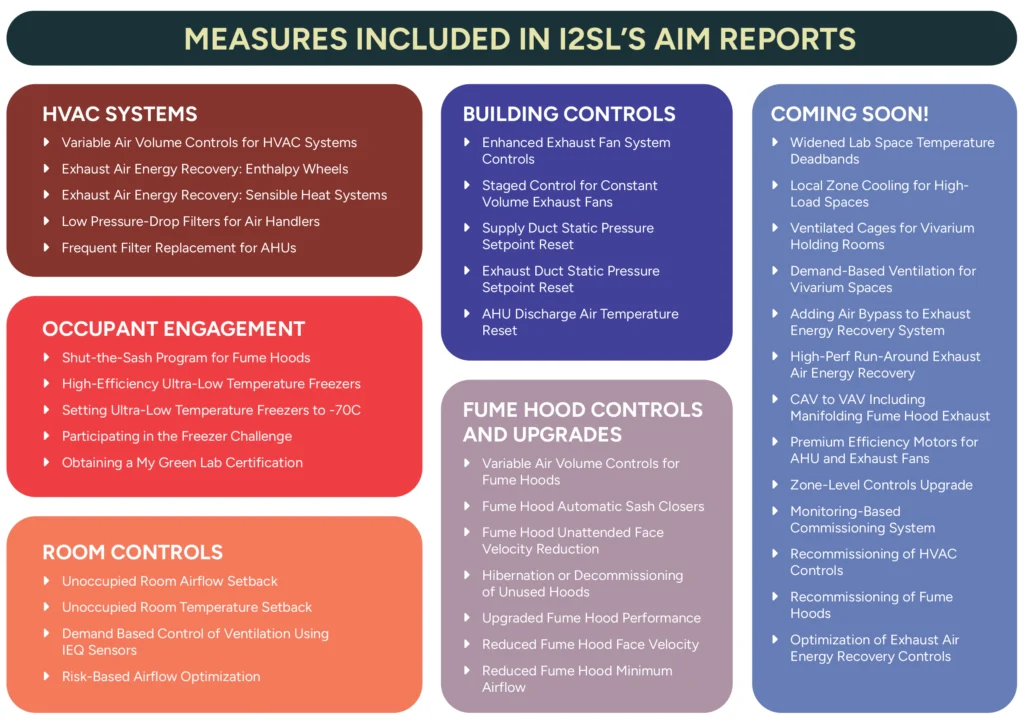
The AIM Report platform is a software-as-a-service subscription product that helps frame the specific energy-saving opportunities applicable to individual lab facilities. In addition to a rapid energy calculator, it contains inbuilt smart assumptions to allow the user to quickly identify and quantify opportunities.
AIM imports the building data entered in the LBT tool, then displays applicable energy-saving measures and allows the user to build a package of measures customised to the facility and to their priorities. For the resulting package, AIM shows estimated cost savings, approximate costs to implement, next steps and stakeholders to involve, plus relevant case studies.
Then it outputs the whole lot as a PDF package ready to share with management, the board or other stakeholders.
Sharp says it can be used for either a single building or a portfolio, and it has been fully internationalised.
“It’s different from a traditional energy audit. And it’s very accessible, very easy to use. You don’t have to be an energy expert. You don’t have to be an engineer to use it. A normal lab owner can use it,” he says.
It’s also interactive, and deliberately unbiased in terms of technology, specific manufacturers or products.
There are currently 26 measures available within the program, based on some of the most common and achievable energy efficiency and emissions reduction approaches. More are in the pipeline.
The dividends
“What’s really powerful about this program is that it doesn’t look at these energy measures individually. Instead, it looks at a package of selected measures together as a group,” says Sharp.
“Many times, when people do energy analysis for buildings, they look at these different measures, but they’re always looked at in isolation, like, oh, I can do this, I can do this, and if I want to do both, I just add the savings together.
“Well, for some measures, that’s fine, but for many measures in lab buildings, to give an example, if you do heat recovery in a building, it’s going to save energy. But if I’m at the same time reducing the airflow, that’s going to reduce how much energy I can save with my heat recovery or vice versa. So, you have to look at these things holistically together as a group.”
AIM considers the interactions between different measures, both in terms of end-result energy savings and in relation to any potential economies of scale relating to implementation costs that may occur if multiple measures are undertaken.
Using AIM on a whole portfolio means that measures can also be prioritised across a tranche of assets. As Sharp observes, it’s not always the obvious contenders in a portfolio that will deliver the best return for investment in energy savings.
For consultants, it can help speed up the process of initial audits so there is more capacity for developing detailed analysis and project approaches.
There is also a dividend for equipment and service providers, who can use the data to gain an unbiased evaluation of the impact of their products and services, says Sharp.
How to get involved
Sharp says currently most of the buildings in the database are from North America. It is hoped more Australian facilities will engage with the LBT, gain some useful insights and add to the growing dataset.
There are also two levels of practitioner accreditation being developed. The first level, Labs2Zero Champion, will soon be available broadly and is a free credential attained through on-line training and a short test.
Sharp explains the goal for this cohort is to help develop a community of allies that are focusing on lab building efficiency and can help people understand the program and the resources that are available.
Labs2Zero Expert, a second level program, is likely to roll out later this year and will involve more in-depth training and practical tests. This aims to create a network of technical experts that are using the tools, can work with clients and train other users and stakeholders.
I2SL has grown from an initial idea sparked at a conference into a global network, Sharp explains. It holds annual awards, and competitions designed to spark innovation and showcase ideas that tackle some of them more challenging technical aspects of optimising performance in labs.
The Australian Chapter is planning an event in October, according to Australian Chapter Vice President, Viscon Systems Managing Director John Penny, M.AIRAH.
Contact the Australian Chapter here
Explore the I2SL tools and upcoming events and programs here
PREV
NEXT
Comments
Advertisements


Recent news
- Global scheme helping laboratories reach net zero
- Daikin’s new IAQ solution for commercial buildings
- Philip Perham steps down from GENERAL
Latest events
- Share your brilliance!
- True Zero Carbon Challenge 2026 Awards Night
- Cool intelligence for flammable refrigerants – celebrating WRD
Leave a Reply