Rethinking airflow: when fan technology becomes a system
Sponsored content from Ziehl-Abegg
Efficiency has become a central topic across the HVAC&R sector, and rightly so. Yet the discussion often remains too narrow in scope. The focus is still frequently placed on the performance of individual components, while the interaction between them receives less attention. In practice, however, overall system behaviour is decisive.
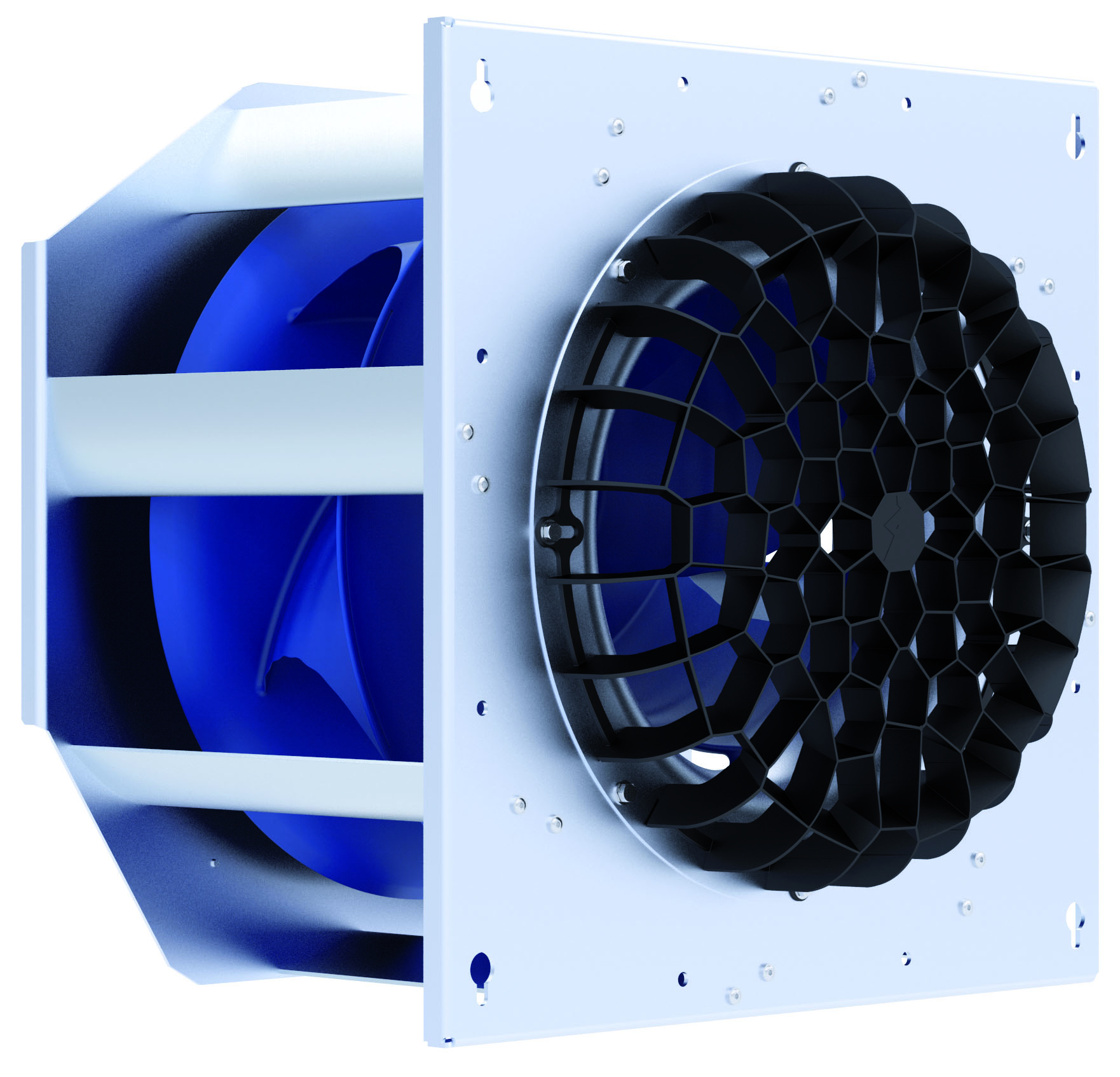
A new generation of fan modules addresses this shift. One example is the ZApilotXL from Ziehl-Abegg, which combines several aerodynamic and mechanical elements into an integrated design.
More than a century of experience in airflow technology
The development of modern ventilation systems does not start from a blank sheet of paper. Ziehl-Abegg has more than 100 years of experience in the design and manufacture of fans, motors and ventilation technology.
More than a century of experience is particularly relevant in applications where systems are expected to operate reliably for decades. Long service life, predictable performance and operational stability remain key requirements in HVAC installations, especially in critical infrastructure and industrial environments. Experience gained across generations of products provides a foundation for continuous development and practical engineering solutions.
From air movement to airflow control
Traditional fans are designed to generate volume flow. Newer approaches go beyond this: they aim to guide, stabilise and utilise airflow more effectively, rather than simply produce it.
In this configuration, the fan, guide vanes and diffuser are combined into a single unit. The objective is not only to move air, but to influence how airflow develops throughout the system. A key aspect is the conversion of dynamic pressure into static pressure, which is the component that can actually be utilised in HVAC applications.
Bionics as a design principle
Bionics is part of Ziehl-Abegg’s development philosophy, and bionic design principles have been applied in fan development for decades, using insights from natural flow structures to improve aerodynamic performance.
In the ZApilotXL, these principles are reflected in the geometry of the guide vanes and impellers. Rather than allowing uncontrolled turbulence, the airflow is stabilised and guided. By reducing turbulence, the airflow remains more stable throughout the system. This not only lowers aerodynamic losses but can also contribute to reduced noise levels, an increasingly important consideration in modern HVAC applications.
The significance of bionics extends beyond individual components. It represents a broader engineering approach in which airflow management becomes an integral part of system design.
Integration of functions
The design brings together multiple functional elements that would traditionally be treated separately. The fan, aerodynamic guidance components and diffuser are matched to each other within a compact structure.
The coordinated interaction of these elements helps minimise flow separation and pressure losses, while supporting a more stable airflow profile across the operating range. In applications such as fan walls, where multiple units operate together, overall performance depends less on individual components and more on how effectively they interact.
Manufacturing depth as an engineering advantage
An often-overlooked factor in ventilation technology is manufacturing depth. Ziehl-Abegg develops and manufactures key components across multiple disciplines and materials, including plastics, aluminium, sheet metal structures, electric motors and aerodynamic components.
This vertical integration allows engineering and production to be closely aligned. For bionic structures in particular, the interaction between material selection, tooling and production technology plays an important role. The ability to combine expertise in plastics, metals and motor technology within one organisation creates additional engineering flexibility and supports application-specific solutions.
Compatibility with existing installations
In practice, mechanical compatibility often limits the adoption of new technology. Many systems are constrained by existing dimensions and mounting points.
The ZApilotXL is designed to align with commonly used interfaces. This allows replacement within existing structures without extensive redesign, reducing installation effort and downtime.
Drive technology in context
The use of electronically commutated (EC) motors enables precise control and adjustment to varying load conditions. This supports efficient operation across a range of scenarios.
In addition, integrated monitoring functions, such as vibration detection, provide data that can be used for condition-based maintenance.
Lifecycle perspective
With energy costs increasing, the evaluation of HVAC systems is shifting towards lifecycle considerations. Operational efficiency, maintenance requirements and durability are gaining importance compared to initial cost alone.
Systems that maintain stable performance over long periods and require less intervention become economically advantageous under these conditions.
A final word
The ZApilotXL reflects a broader development within the industry: a move away from isolated component optimisation towards integrated system design.
In practical terms, system performance is increasingly defined not by individual components, but by how effectively aerodynamics, drive technology and mechanical design are engineered to work together.
PREV
NEXT
Comments
Advertisements
Recent news
- Adam Morgan shines in Shanghai
- Next-gen solar
- Shaping the future of Building Energy Performance standards
Latest events
- Adam Morgan shines in Shanghai
- IOR opens nominations for J&E Hall Gold Medal
- Nominations open for IIR scientific prizes
Leave a Reply