 Willow Aliento
Improving the reliability of energy ratings for air conditioning
Revisions are now likely to the standard underpinning air conditioner seasonal energy efficiency performance, following a review by the Department of Climate Change, Energy, Environment and Water (DCCEEW).
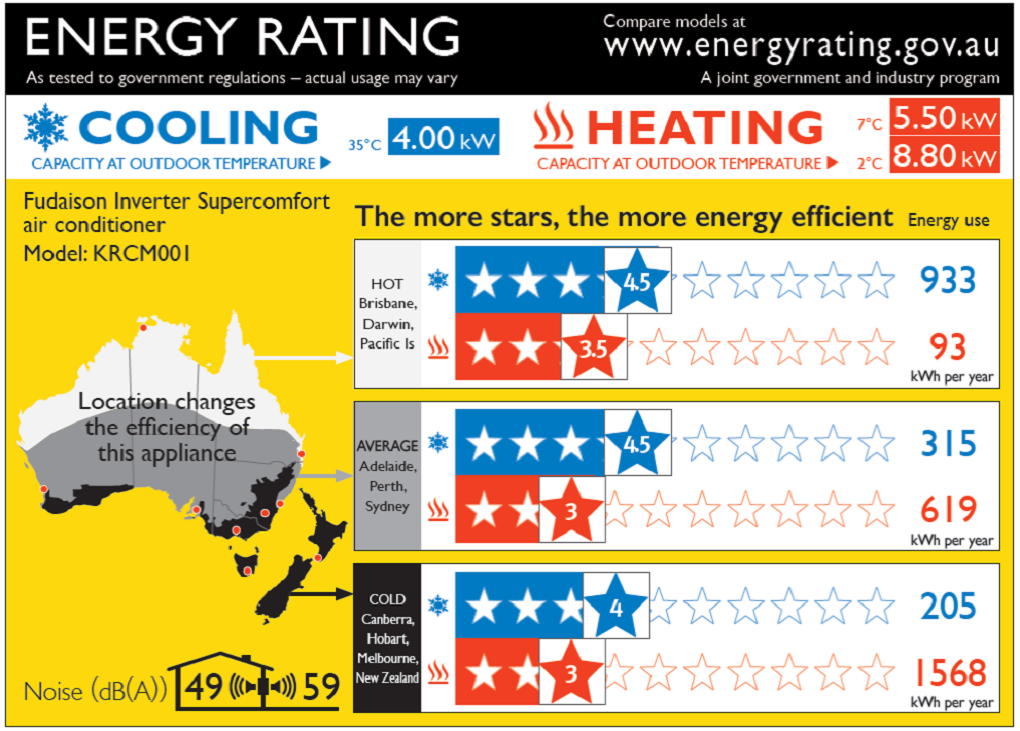
Energy ratings for air conditioners are mandatory in Australia under the Greenhouse and Energy Minimum Standards Act 2012 (GEMS Act). However, issues had been identified in the method of cooling seasonal energy performance calculations which resulted in energy rating estimates of cooling energy use not matching actual performance.
As Dr Greg Picker, policy adviser at AREMA (Airconditioning and Refrigerant Equipment Manufacturers Association of Australia) explains, the standard allowed units to appear to operate at “energy negative” performance.
In effect, it would look like they generated energy under certain conditions, which then gave a lower annual energy use when the Energy Star rating was calculated over the entire year.
The background
Seasonal performance ratings for air conditioners were introduced in 2019 and became mandatory for new air conditioner models in Australia in 2020 and New Zealand in 2021.
The Zoned Energy Rating Label (ZERL) gives information on seasonal performance, along with the star rating and annual running cost for heating and cooling across three climate zones in Australia and New Zealand.
Under the standard, the performance of air conditioners is calculated for three climate zones: Hot & Humid, Mixed, and Cold, with specific parameters for assumed cooling hours and relevant set points under Residential and Commercial usage profiles.
The equations behind the star ratings and cooling-related energy consumption figures come from the standard AS/NZS 3823.4.1 2014 +A1 – Air conditioners – Cooling seasonal calculations and also (in Australia) the Greenhouse and Minimum Energy Standards (GEMS) Determination. This standard is based on an international standard, which contained the same issue.
“There is a flaw in the equations that allows the energy efficiency of air conditioners to be overstated for cooling, implying lower energy consumption and earning more stars than what can be reasonably achieved by a product,” DCCEEW notes in the consultation paper.
“This issue can result in a 17% increase in Total Cooling Seasonal Performance Factor (TCSPF) for the Residential use case in the Cold zone and a 310% increase in TCSPF for the Commercial use case in the Cold zone. This is misleading to purchasers of air conditioners and disadvantageous for businesses who do not take advantage of this flaw in the equations.”
The error in the standard – both in Australia and internationally – has subsequently been resolved, thanks to an amendment developed and proposed by Australia’s standard committee and accepted globally.
The consultation
In September 2025, DCCEEW released a technical consultation paper, and stakeholder views were sought on two technical issues for air conditioners:
- The minimum temperature at which cooling is assumed to be used in performance calculation for air conditioners in commercial settings
- How rated values for capacity and input power are treated in the Australian Determination and NZ’s EUP regulations.
Seven submissions were received during the consultation period, including one from AREMA. DCCEEW has considered the industry feedback and says the determination is going to be amended to rectify the calculation issue.
What needs to be considered is transitional arrangements to mitigate how the change will affect existing equipment. Proposals include grandfathering existing models to allow them to retain existing Energy Star ratings.
DCCEEW estimates the new specifications proposed in the summary paper would result in approximately 26% of registrations being affected and approximately 35% of labelled models being affected and consequently needing to be changed.
Next steps
DCCEEW says details of proposed changes will be set out in an exposure draft of updates to the Greenhouse and Energy Minimum Standards (GEMS) (Air Conditioners up to 65kW) Determination 2019, which is slated for release in late 2026 for public consultation.
Based on the review and stakeholder consultation, the proposed specifications listed below have been identified to address cooling seasonal performance calculation issues for air conditioners:
- The minimum temperature at which cooling is assumed to be used in performance calculations (T0) to remain unchanged for both commercial and residential use case calculations.
- The validity test in the revised standard AS/NZS 3823.4.1:2014 that is applied to tested values to be applied to rated values used in seasonal cooling performance calculations.
- An additional validity test to be introduced based on a ‘zero slope’ test (the slope of the line between the line drawn from tested power input values and the line drawn based on rated power input values) where the slope derived from the rated power input values cannot be more than the slope derived from tested power input values:
- For each capacity line (Full Capacity, Half Capacity and Minimum Capacity).
- At the conditions of T1 (35°C) and Low Temperature Cooling (29°C).
Dr Picker notes that ensuring the accuracy of energy ratings is critical: consumers rely on them in choosing products, states use them to roll out incentives programs, and they provide the basis for governments to assess and set future energy efficiency policy.
“Industry and Governments have a responsibility to ensure assessments of product efficiency are accurate,” he says.
“Solving this issue promptly is vital and AREMA welcomes the action that GEMs and the Government are taking to fix this problem.”
- Access the consultation documents and view industry submissions here.
Main image source: energyrating.gov.au
PREV
NEXT
Comments
Advertisements

Recent news
- Crooks cook French frozen food aisles
- Beating the heat on high rise sites
- Global reach, local innovation
Latest events
- Adam Morgan shines in Shanghai
- IOR opens nominations for J&E Hall Gold Medal
- Nominations open for IIR scientific prizes
Leave a Reply