 Willow Aliento
Seeing all-electric stars in the NABERS Annual Report
The NABERS Annual Report for 2025/26 shows collective progress is being made across energy efficiency, electrification, indoor environment, energy management innovation and embodied carbon.

In a world of fleeting red-carpet glories, NABERS gives us the kind of stars we can build a sustainable future on. The 2025/26 Annual Report showcases the way the toolkits and the data are continuing to progress positive shifts in energy use, including both quantity and source, while also encouraging progress on water efficiency, waste reduction, indoor environment quality and embodied carbon management.
Over the 12 months of 2025/26 FY, there were 7,881 NABERS ratings certified across all categories, including the first NABERS Embodied Carbon rating in December 2025, for Frasers Property Industrial’s Kemps Creek facility, delivered with Mainbrace Constructions and tenant Probiotec.
67 Portfolios across 31 companies participated in the 2026 Sustainable Portfolios Index (SPI), comprising 402 office assets, 36 hotels and 6.3 million square metres of shopping centre space.
NABERS also progressed work on energy rating tools for new asset categories, including purpose-built student accomodation and apartment buildings. Work with the data centre sector is also advancing, including feasibility studies on potentially incorporating water metrics, such as source and water efficiency, into the NABERS Energy for Data Centres ratings.
The annual report says stakeholders have told the NABERS team there is “an urgent need to understand holistic (data centre) sustainability performance, particularly as some technologies that improve cooling efficiency can increase water consumption.”
Problems can become positives
In the Welcome Letter to Stakeholders by NABERS Director, Carlos Flores, he highlights both the responsibility the built environment has to reduce emissions, and the “extraordinary opportunity” for the sector.
“The actions we take in the building sector can support or directly drive major emissions reductions across the Australian economy,” he writes.
“Buildings need to electrify. We need to shift when buildings use electricity to make better use of abundant renewable energy. We need to reduce the embodied carbon in building materials. We need to address barriers to EV charging in buildings. And we need to do all of this while maintaining a laser focus on energy efficiency.
“Luckily for us, many of these actions also carry very positive economic benefits. Energy efficiency and rooftop solar can help Australian households and businesses permanently reduce energy costs and improve affordability. Falling technology costs and availability have added several more tools to our cost-reduction toolkit, which now include EVs, batteries and heat pumps.
“In many ways, this annual report is the story of NABERS getting ready for the bigger role our sector must play in the decade ahead.”
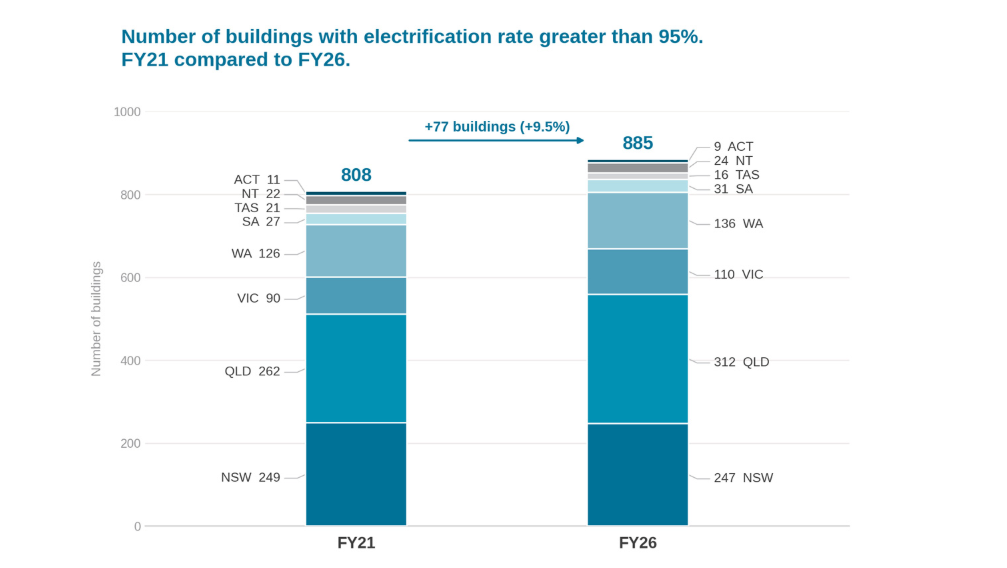
That includes work underway on the NABERS Energy 2030 update, which will support the shift to all-electric buildings and reward energy efficiency. The 2025/26 data shows that already, 31 existing office buildings and shopping centres have hit over 95% electrification in the last five years.
As the graph below from the report shows, this momentum is already accelerating. The graph shows the number of buildings with electrification rate greater than 95%, for FY21 and FY26, broken down by state.
Government engagement
In her Welcome Letter, Michelle Croker, NABERS National Steering Committee Government Chair, flagged some important Federal Government initiatives that will both support the ongoing expansion of NABERS capabilities and will also be leveraging the tools to help achieve policy priorities.
For example, Croker noted the major milestone of the release of the Australia’s Government’s Built Environment Sector Plan (BESP) in September 2025.
“The plan sets out the pathway for Australia’s built environment to achieve net zero emissions by 2050 and recognises the important role NABERS plays in supporting this transition,” she writes.
A commitment of $9 million over four years has been allocated to expand NABERS and the Commercial Building Disclosure (CBD) Program.
“This funding will further develop rating tools and extend to new sectors, increase voluntary disclosure rates and deliver useful products for industry in emerging areas such as energy flexibility and embodied carbon,” Croker writes.
The CBD Roadmap, also released in September 2025, proposes expanding mandatory disclosure of NABERS ratings to more asset types and sectors, including all commercial office tenancies, hotels, data centres and public buildings.
Released in December 2025, the Trajectory for Low Energy Buildings Implementation Plan also recognises the important role of NABERS in reducing emissions and energy demand through disclosure of ratings, building electrification, improved energy efficiency and the measurement of embodied carbon, Croker says.
“The launch of the first public NABERS Embodied Carbon rating by the Assistant Minister for Climate Change and Energy, the Hon Josh Wilson MP, in late 2025 reflects the growing importance of being able to measure, verify, and compare the upfront embodied carbon with similar buildings.”
Flexes are the new negawatt
The Federal Government is also supporting further investigations into energy flexibility. In early 2026, NABERS completed the Energy Flexibility in Commercial Buildings Feasibility Study, which aimed to explore how commercial buildings can support a more flexible electricity grid through shifting time of use, storing energy and sharing energy.
The initial research drew on insights from 72 stakeholders. It found that while there are currently few commercial buildings flexing, the case for doing so “is becoming more compelling as time-of-use tariffs, incentives and new sustainability requirements emerge,” NABERS states.
The data shows that if buildings shifted one-third of peak electricity use to the middle of the day, it could save $1.7 billion annually.
Energy flexibility could also achieve an estimated 2.78 million tonne reduction in energy-related greenhouse gas emissions annually and deliver a 52% boost to peak electricity capacity – equivalent to just over half the electricity provided by Australia’s existing coal generation fleet.
The report was launched in July 2026, and NABERS has now commenced a three-year federally funded program to develop and test metrics for energy flexibility.
Progress is not linear
Flores observes in his letter that over the last decade, NABERS has rated more than 9,000 buildings and certified over 55,000 individual ratings.
“From those rated buildings, 15.2 million tonnes of emissions have been avoided, and $2.1 billion in energy costs saved,” he writes.
“This did not happen by chance. It represents the collective achievements of thousands of sustainability champions, facilities managers, corporate sustainability teams, consultants, contractors, NABERS Assessors and more.
“In 2026, Australia has arguably the world’s most experienced sustainability workforce for large buildings. We know how to make buildings better, because we have been doing it for decades. And we will need every bit of that experience going forward, as the role buildings play in helping Australia meet its emissions reduction targets expands.”
- Access the online NABERS 2025/26 Annual Report Hub here
PREV
NEXT
Comments
Advertisements

Recent news
- Seeing all-electric stars in the NABERS Annual Report
- City Facilities Management secures decade-long Coles deal
- Delivering energy wins through cooling innovation
Latest events
- Adam Morgan shines in Shanghai
- IOR opens nominations for J&E Hall Gold Medal
- Nominations open for IIR scientific prizes
Leave a Reply