 Willow Aliento
The true carbon cost of data centres
A new report by MECLA highlights the embodied carbon in data centre developments – and the huge contribution made by HVAC and other building services.
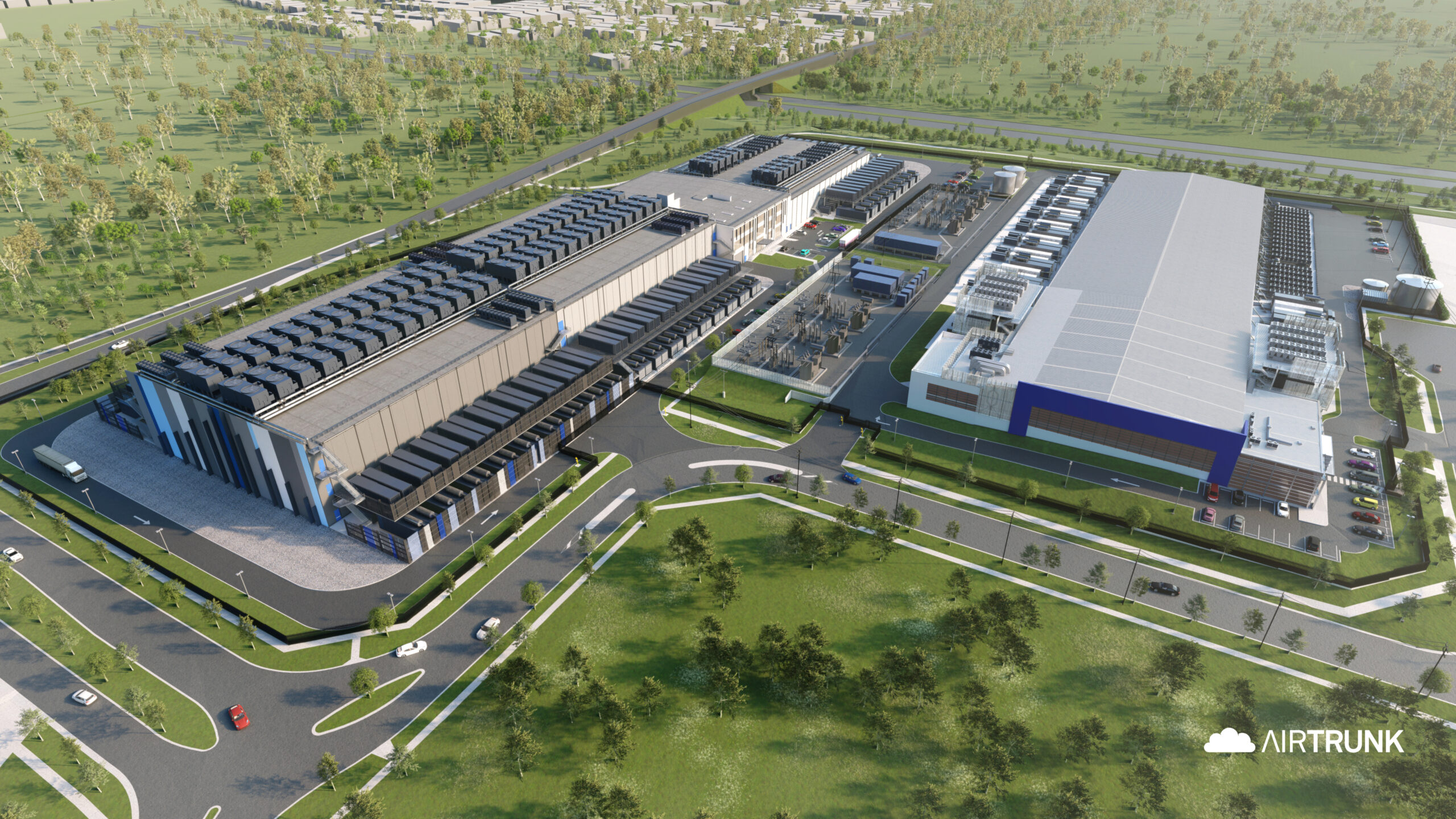
MECLA (the Materials and Embodied Carbon Leaders’ Alliance) recently celebrated five years of raising awareness about embodied carbon and driving lower-carbon solutions. Now the group has turned its attention to the hot topic of data centres in a new report: The Next Frontier: Reducing Embodied Carbon in Data Centre Development.
Although there has been a much discussion about energy and water use in data centres, the report fills an important gap by looking at scope 3 emissions. And the information it reveals is of particular interest to those working in HVAC.
MEP the big contributor
The report notes that embodied carbon presents a distinct challenge in data centres because of their unique typologies and technical systems. Key factors include the complexity of mechanical, electrical and plumbing (MEP) systems, elevated wall-to-floor ratios, and the density of IT equipment that data centres are designed to support.
In most buildings, services account for only around 14% of the upfront embodied carbon of the asset. In data centres, however, that proportion is up to 60% – and up to 90% for cumulative whole-of-life embodied carbon emissions.
Data centres rely on HVAC equipment to maintain thermal conditions and limit humidity to ensure optimal operating conditions for data halls. This means there is both a substantial upfront carbon bill from the manufacture, transport and installation of every element of the HVAC system, and an ongoing embodied carbon contribution from equipment maintenance, repair and replacement activities.
The report observes that one of the challenges for managing embodied carbon is limited data and environmental product declarations (EPDs). Also, the rate of technology and product change in HVAC often outpaces the speed at which lifecycle assessment platforms and data sets integrate information. This means that if carbon benchmarks are used for a project proposal, they may not reflect what’s available in the market.
Keeping pace with fast tech
Another challenge is the pace at which projects move from planning to delivery. MECLA Project Manager and report author, Alexi Barnstone, says it’s not about slowing projects down overall. Rather, it’s about working through decisions at the right point and having sustainability in mind from early in project conception, particularly where MEP choices lock in long‑term carbon, cost and resilience outcomes.
“Speed is a commercial reality in data centre delivery, and that’s unlikely to change,” he says. “What the workshops we conducted for this report highlighted is that some early MEP decisions – particularly around cooling architecture, power redundancy, UPS and generators – lock in carbon, cost and performance outcomes for decades.”
According to Barnstone, when these decisions are made before whole‑life carbon implications are visible, the risk isn’t speed itself, but locking in avoidable waste.
“The opportunity is to front‑load better information and benchmarks, so once the system intent is set, projects can still move fast without sacrificing long‑term outcomes,” he says.
The report puts forward strategies for reducing the embodied, lifecycle carbon of HVAC. These include both passive measures such as altering operating temperature and humidity benchmarks, and active measures such as designing for hybrid cooling or immersion cooling.
Metrics matter
Some global operators are beginning to consider embodied carbon alongside energy efficiency and water efficiency as a key sustainability metric – in line with their public 2030 or 2040 net zero commitments. According to the report, several industry bodies are now targeting a 40% reduction in embodied carbon by 2030 alongside net zero operational goals.
Barnstone sees this as an important shift.
“The current momentum sits with developers and clients, and is being amplified by finance and government policy such as ASRS reporting which will increasingly pull the supply chain along with it,” he says. “Suppliers and contractors need to see low embodied carbon asks and requirements in procurement to justify their own investments in low carbon solutions for the market.
“The strongest momentum today is coming from the hyperscalers, who understand their role and demand side power in driving change in industry through engagements with their supply chains. Many of these organisations, like Meta, Amazon, and AirTrunk, are now quantifying embodied carbon across portfolios, embedding it into corporate KPIs and governance, and developing sector-appropriate benchmarks (e.g. per kW of IT).”
According to Barnstone, this is reinforced through sustainability‑linked loans, investor scrutiny and mandatory climate disclosures, which elevate embodied carbon into a material risk and reporting issue.
“Supply chains matter hugely, but consistent client demand is what activates change there – not one‑off requests.” – Alexi Barnstone
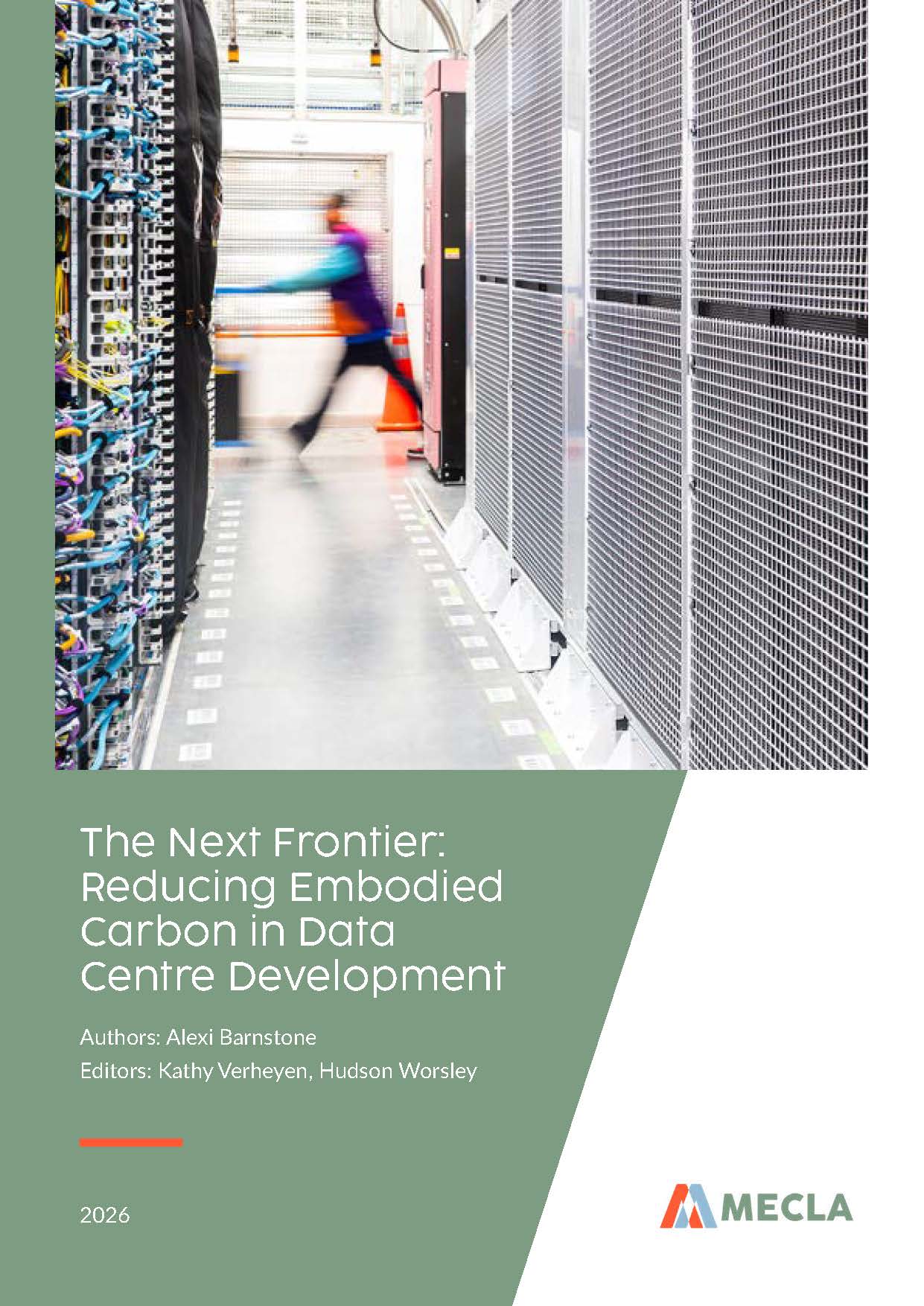
The report includes detail from AirTrunk, which in 2024 introduced an Embodied Carbon Ratio (ECR) to guide low-carbon design across its campuses. The ECR is a ratio of the embodied carbon emissions from construction and fitout divided by the IT capacity of the data centre and expressed in tCO2e/kW IT.
The report notes that some other developers are using a metric that is based on embodied carbon per square metre of operating data hall area.
Technologies and tradeoffs
A key point is that decisions around design and specification of cooling also intersect with energy and water efficiency. Tradeoffs need to be considered.
According to the report, embodied carbon and water use in data centres are tightly linked, with cooling system choices often shifting impacts between the two. Using some water for cooling, such as evaporative systems and cooling towers, can enable simpler, less material-intensive plants and avoid chiller-heavy designs with high embodied carbon and refrigerant impacts.
Fully water-free approaches typically require more chillers, coils, and pipework, increasing both embodied carbon and operational energy, and are only clearly advantageous in a small number of very cold climates when outside-air economisation is not a viable strategy. Running data centres at higher allowable temperatures further reduces water demand by cutting evaporative cooling hours and intensity, offering a direct co-benefit for both carbon and water stress.
“Detailed system comparisons show how these trade-offs play out in practice,” the report reads. “Liquid cooling loops for IT are typically closed-circuit (glycol-water), but their heat-rejection options – cooling towers, dry coolers, diabatic coolers, or liquid-to-air in the data hall – each carry distinct water and carbon profiles that need to be evaluated on a whole-of-life basis.”
Could data centres drive change?
Until now, it has been challenging to reduce embodied carbon in building services because attention tends to centre on larger structural materials like steel and concrete. There is hope that the huge impact of building services in the embodied carbon of data centres could help drive lower-carbon solutions in this area.
Barnstone believes data centres are well placed to become an MEP innovation engine.
“They are unusual in that MEP systems account for a major portion of the embodied carbon and performance is mission‑critical.” he explains.
“That makes them an ideal test bed for rethinking system designs and implementing lower embodied carbon solutions. Furthermore, MEP systems in data centres are complex and often site specific, requiring nuanced solutions specific to the case to reduce their environmental impacts.
“If innovation begins to occur in this space, the rollout of more generalised products with lower environmental impact should easily follow.”
Barnstone sees other high-reliability building types – such as healthcare, laboratories, advanced manufacturing, and infrastructure-adjacent buildings – as the prime candidates for these innovations.
“The value isn’t copying data centres wholesale, but applying the same level of scrutiny to MEP choices that historically received far less carbon attention than structure or operations. If the data centre industry can build an approach to MEP that can be adapted to other contexts, it will help shift the sectoral dial as a whole.”
Read the report here.
For more information on MECLA and the Building Services Working Group, visit the MECLA website.
PREV
NEXT
Comments
Advertisements

Recent news
- Beijer Ref appoints new CEO
- Building ministers pledge NCC modernisation
- Recognising and celebrating progress and change
Latest events
- Recognising and celebrating progress and change
- Adam Morgan shines in Shanghai
- IOR opens nominations for J&E Hall Gold Medal
Leave a Reply