 Willow Aliento
Crooks cook French frozen food aisles
A cyberattack on supermarkets in France has caused tonnes of fresh food products to be discarded. The hackers exploited a smart control system on chilled and frozen food units, something security experts have previously suggested was a matter not of “if” but “when”.

Reuters has reported the attack began on the night of Sunday October 11 (Monday October 12 in Australia), and affected hundreds of supermarkets across the country, including major retail chains Intermarché (owned by Les Mousquetaires), Netto, Carrefour and Cooperative U.
The attack targeted older Danfoss control systems for refrigeration and freezer units, sending the systems into a continual defrost cycle which resulted in temperatures rising to around 50oC in some cases.
HVAC&R News has not found any published statements around motive for the attacks at the time of writing, nor has any group been named as suspected of being responsible.
According to the Reuters reporting, the impacts ranged from elevated temperatures in the cold food aisles and defrosted or heated food within units, and in the most extreme cases, small fires.
It is believed supermarkets in Spain, Portugal, Poland, Germany and Belgium have also been affected, according to Reuters.
- Read the full Reuters story here.
System vulnerabilities had been identified
The vulnerability of older smart control systems was flagged earlier this year by cybersecurity firm, Claroty8. The report released by the company in July focused on the risks for data centre operations.
Danfoss was one of the OEM companies mentioned in the report, and it had issued an advisory relating to equipment controller management, along with an update for AK-SM 800A controllers.
- Read that story here.
A spokesperson for Danfoss told Reuters that the affected supermarkets were “running outdated firmware”.
Danfoss also provided a statement to the Cooling Post, stating that the majority of affected refrigeration systems were either legacy products or newer products “running outdated firmware”. These include the AK-SM800, which Danfoss declared end-of-life in 2021 and AK-SC355 systems, which were phased out in 2016.
- Read the Cooling Post story here.
Cyber attacks on the food system are not rare events, according to research by Kulkarni et al published in 2025 in the International Journal of Food and Agriculture Research.
A review of cybersecurity incidents in the food and agriculture sector found 397 security incidents and 115 security breaches from 2015-2023.
The team undertook a detailed examination of 30 of these incidents which had been identified and reported on by the FBI, media and the affected organisations.
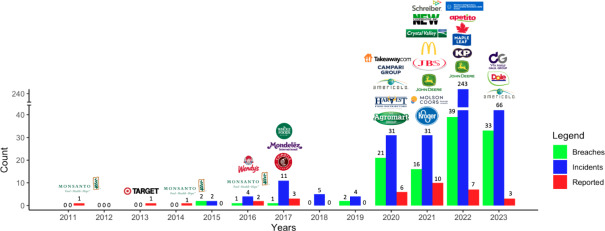
Figure: The timeline of 397 security incidents and 115 security breaches from 2015 to 2023 in the food and agriculture domain. The security incidents reported in the survey are shown using company logos from 2011 to 2023. Source: Kulkarni et al (2025).
The attacks affected a range of systems including livestock breeding management software, smart farm equipment sensor networks, water supply facility sensors, drone data and control systems, order management systems and financial and customer data held by retailers, restaurants or delivery services.
The most common type of attack in the sector had been ransomware attacks, followed by data breaches that give the criminals access to operational, financial and/or sensitive personal information such as names and addresses of staff or customers.
The researchers also evaluate a range of cybersecurity frameworks and standards that may help organisations in the sector minimise and prevent cyberattacks.
“Farm production, food processing, and supply chains are vital to the global food security network, but their connections with emerging technologies make them vulnerable to cyber threats,” state the researchers.
“The cyberattacks targeting critical nodes within the sector, such as meat, dairy, frozen food, and restaurant supply chains, disrupt the flow of essential food items to consumers. These disruptions could occur throughout the entire production and distribution network. It causes shortages in crucial food categories compromising the variety and availability of products on store shelves.”
- Read the full research paper here.
In France, this is now unfolding in real time. Millions of Euros of food has had to be disposed of due to food safety concerns, and the BBC reports that French prosecutors have now opened a cyber-crime investigation into the incident.
According to the BBC report, European Food Commissioner Christophe Hansen has posted on social media that, food security requires more attention, because “the weaponisation of food has become a reality.”
Main image: photo by Robert Lens from Pixabay
PREV
NEXT
Comments
Advertisements

Recent news
- Crooks cook French frozen food aisles
- Beating the heat on high rise sites
- Global reach, local innovation
Latest events
- Adam Morgan shines in Shanghai
- IOR opens nominations for J&E Hall Gold Medal
- Nominations open for IIR scientific prizes
Leave a Reply