Engineering the oil-free future
Manfred Jarchow, M.AIRAH, Technical Business Development Manager, Aureacor, explains the rise of oil-free magnetic levitation in Australian chiller design, and how a strategic global partnership and a homegrown design authority are paving the path to strict NCC 2025 readiness and high-efficiency NABERS alignment.
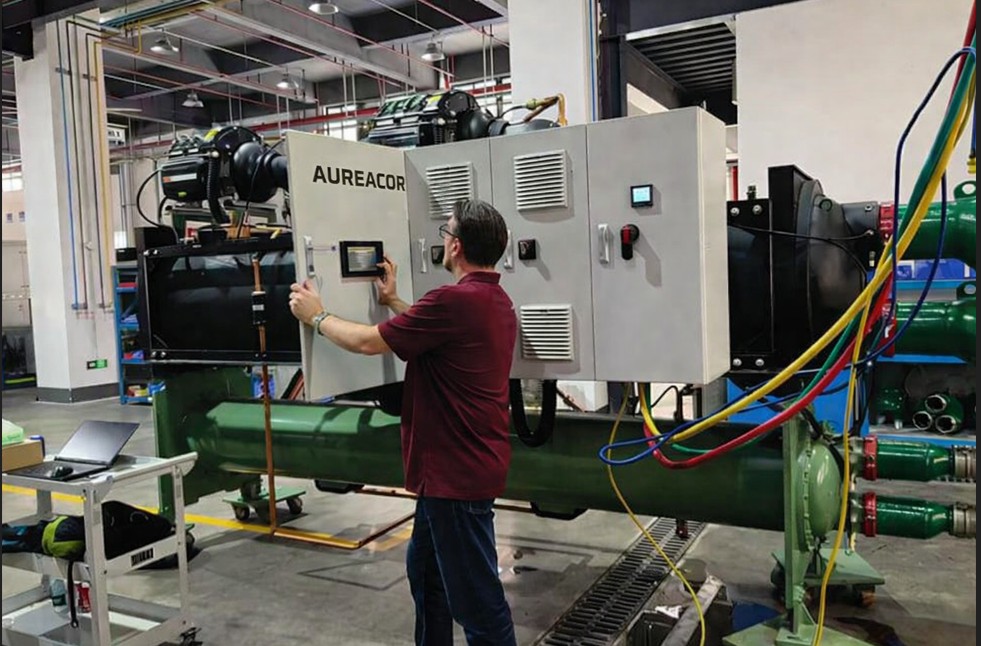
The Australian HVAC&R and industrial process cooling landscape is facing a pivotal transition. With the National Construction Code (NCC 2025) introducing stringent energy performance and sustainability thresholds, alongside the rising market priority for high NABERS ratings, engineering teams are pushed to rethink traditional systems.
Traditional chillers, dependent on oil-lubricated compressors, possess inherent mechanical complexities. Over time, oil migration into the refrigeration piping creates a thermal barrier, reducing heat transfer efficiency and demanding intensive annual maintenance cycles.
Developed by Apveek and supported by Kingfit Group, Aureacor is an advanced oil-free magnetic bearing centrifugal chiller specifically tailored to meet local regulatory and commercial compliance benchmarks.
By removing oil from the refrigeration cycle entirely, Aureacor targets the core problems of long-term efficiency degradation, simplifying industrial cooling infrastructure while offering major life-cycle cost benefits.
The philosophy of clean thermal performance
The heart of the design philosophy is eliminating friction. The technology utilises advanced magnetic bearing compressors that leverage digitally controlled magnetic fields to levitate the internal drive shaft. Because the shaft rotates at high speeds without making physical contact with its housing, mechanical wear and frictional losses are eliminated.
This friction-free rotation also plays a role in part-load performance. Chillers in typical commercial applications spend over 90% of their operating life at part load, making Integrated Part Load Value (IPLV) a far more critical metric than full-load performance alone. Backed by variable frequency drives (VFDs) that adjust compressor motor speed in real time, the system matches real-world building loads with precise granularity.
Furthermore, omitting oil significantly advances thermal efficiency. In standard flooded evaporators, even a minor oil film on copper heat exchanger tubes penalises the heat transfer coefficient. By contrast, an oil-free flooded evaporator design ensures heat transfer surfaces remain pristine throughout the unit’s entire operational lifespan, protecting the system’s day-one efficiency from decaying.
Scalable supply and empirical validation – global scale, local compliance
A major challenge for boutique engineering innovations is securing reliable, high-volume production without losing quality control. Apveek has solved this through a robust joint-venture supply chain. Aureacor chillers are assembled and tested at the Chinese plant of Kingfit – a Danfoss-approved OEM manufacturer.
This setup bridges the gap between premium global components and competitive lead times. The advanced Danfoss Turbocor range is integrated directly into a structure customised by the Australian engineering team, which satisfies Australian safety, electrical, and structural standards right out of the box.
Real-world field application and layout
From an installation perspective, the lack of reciprocating or heavy friction parts translates to exceptionally low vibration and minimal noise profiles. Heavy, costly inertia blocks are obsolete; standard 10mm anti-vibration rubber isolation padding is sufficient for standard plant room floors.
To optimise plant layouts, engineers must account for routine maintenance access. The technology’s compact architecture has an operational weight of 5,350 kg and clear service access allocations.
Certified validation: the numbers behind the technology
To verify the design metrics before deployment, units undergo strict empirical validation under standard testing conditions. Utilising data from official factory records, the tables below outline the structural boundaries and true thermodynamic performance profiles of the product line.
Table 1: Equipment physical & weight profile
(Data Source: Verbatim from Final Assy: ATT100-2H / Technical Documentation)
| Parameter Metric | Certified Value Specification |
| Operating Weight | 5,350kg |
| Shipping Weight (Charged) | 4,650kg |
| Shipping Weight (Uncharged) | 4,340kg |
| Evaporator Connection Size | 2x Ø200 mm (8″) Grooved |
| Condenser Connection Size | 2x Ø150 mm (6″) Grooved |
| Total Chiller Frame Length | 4,169mm |
| Total Chiller Frame Height | 2,362 mm |
Table 2: Thermodynamic test rig performance
(Data Source: Empirical factory testing verified in Test Rig Performance Sheet-AUC-2603.xlsx and Performance Sheet-ATT031.1BXXX.VNP.S4S4GN_STD_0126.xlsx)
| Performance Metric | Measured Test Value |
| Nominal Cooling Capacity | 352kW / 100 Tons |
| Refrigerant Type | R134a (Low-GWP Optimized) |
| Full Load Power Input | 64.2kW |
| Full Load COP (Coefficient of Performance) | 5.48 |
| Integrated Part Load Value (IPLV) | 9.12 |
| Evaporator Entering/Leaving Water Temp | 12.0°C / 7.0°C |
| Condenser Entering/Leaving Water Temp | 30.0°C / 35.0°C |
Future-proofing sustainability
By demonstrating an IPLV that exceeds standard industry minimums, Aureacor meets the needs of premium, energy efficient commercial retrofits. Combined with a modular compressor framework with built-in mechanical redundancy – preventing building downtime if a single compressor requires service – the system marks a decisive shift away from high-maintenance, oil-laden cooling solutions.
PREV
NEXT
Comments
Advertisements
Recent news
- Seeing all-electric stars in the NABERS Annual Report
- City Facilities Management secures decade-long Coles deal
- Delivering energy wins through cooling innovation
Latest events
- Adam Morgan shines in Shanghai
- IOR opens nominations for J&E Hall Gold Medal
- Nominations open for IIR scientific prizes
Leave a Reply