New fire safety maintenance regs in NSW
Changes to fire safety maintenance requirements are now in effect for New South Wales, with important implications for HVAC&R practitioners.
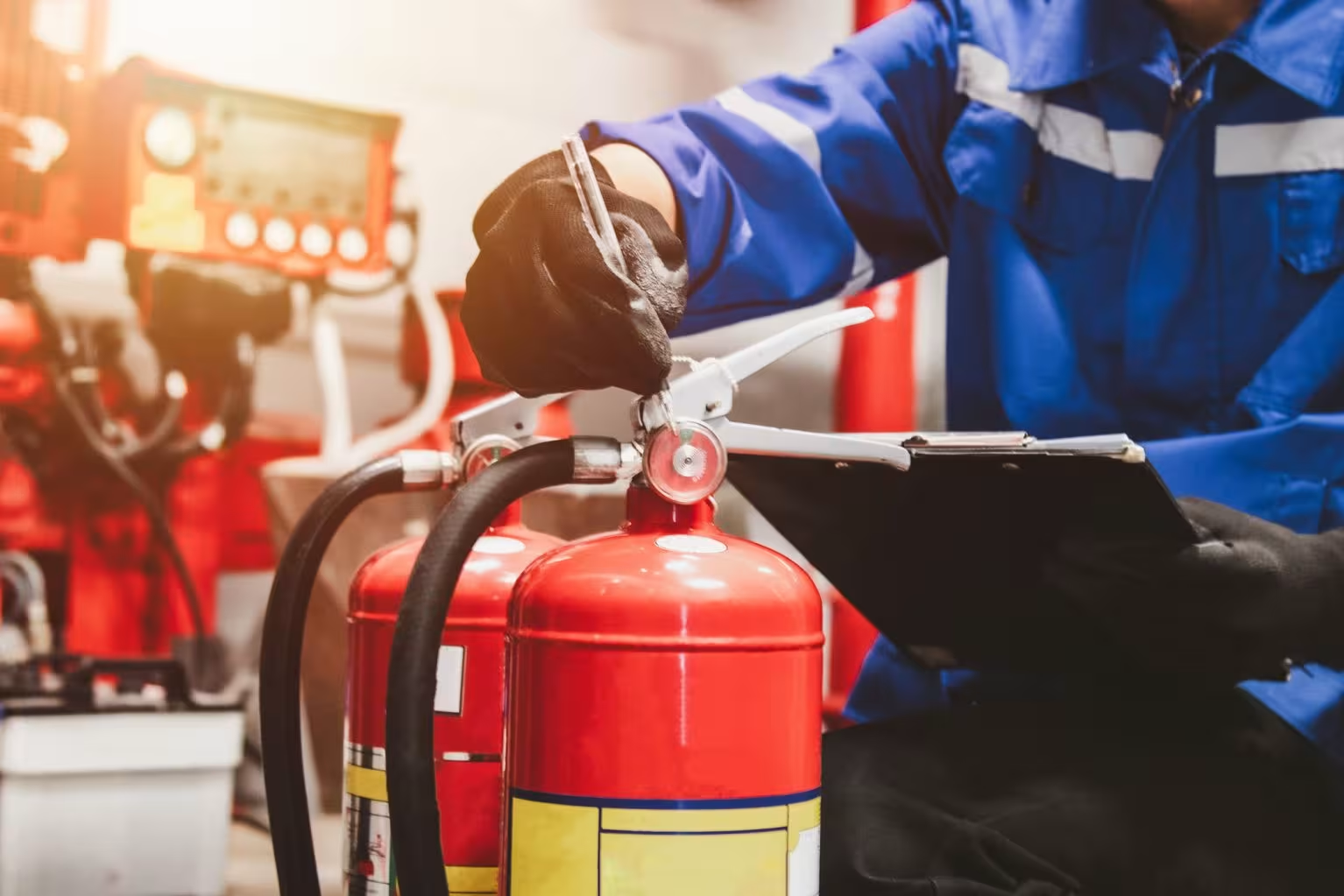
From February 13, 2026, all class 1b and class 2 to class 9 buildings in NSW must have essential fire safety measures inspected, maintained and tested in accordance with AS 1851-2012.
The reform comes after a 12-month delay to allow industry time to prepare. Although building owners in NSW already had an obligation to inspect and maintain, there is now a better-defined and consistent way to meet the obligations. This brings NSW into line with most other states around Australia, where AS 1851 is already mandatory for maintenance of fire safety measures.
Building owners in NSW are now required to keep maintenance records in line with AS 1851. Logbooks can be digital or hard copy, but a hard copy must be left on site at the conclusion of all routine service activities.
Local councils have powers to inspect maintenance records and can issue penalties for any breaches. There are significant penalties for non-compliance, including fines of $33,000 for individuals and $66,000 for corporations.
Impact for HVAC&R practitioners
It is important for HVAC&R practitioners to be aware of the new rules.
“With AS 1851 now a statutory requirement in New South Wales, it’s on us in the mechanical services field to ensure our technicians have the right competency and a solid understanding of smoke control systems,” says Ivan Steed, M.AIRAH, Essential Services Team Leader at Grosvenor Engineering Group and AIRAH’s representative on the Standards Australia committee for AS 1851.
“Let’s treat this as an opportunity not just to comply with a legal requirement, but to raise the level of competence and literacy across our entire industry.”
Fire and smoke control features of mechanical services are covered by Section 13 of AS 1851. They include active fire and smoke dampers, as well as stair pressurisation, and other smoke control, exhaust and air-handling systems.
While the fire and smoke control features of all mechanical services must be inspected and serviced, the testing requirements of Section 13 of AS 1851 are only relevant to systems that operate in fire mode (including any shutdown operation). Refer to Section 13 of AS 1851 for more information.
Baseline data and Annual Fire Safety Statements
One of the concerns raised while planning the reform was the lack of baseline data on fire safety systems in many buildings in NSW. It was predicted that making maintenance to AS 1851 mandatory could highlight the extent of this issue, and represent a major challenge for fire safety contractors – as well as a major expense for building owners.
As part of the change, the NSW Fire Safety Industry Reference Group – which includes AIRAH, AMCA and FPA Australia – has developed the Good practice guide for implementing AS 1851-2012. The guide the specific tasks for which baseline data are required, as well as information to help building owners understand and comply with the new requirements.
If baseline data is not available, maintenance should continue, and the missing data should be recorded as a non-conformance. It is the building owner’s responsibility to engage professionals to obtain this data.
The new requirements supplement the need for building owners to demonstrate through an annual fire safety statement (AFSS) that each essential fire safety measure in the building has been verified as being found to be capable of performing to the required standard. Regular maintenance of essential fire safety measures underpins the AFSS process, however, there is no statutory link between the maintenance requirements of AS 1851 and the issuance of an AFSS in NSW.
Want to know more?
For more information, visit the Building Commission NSW website.
Guidance on the application of AS 1851 to mechanical fire safety systems is covered in AIRAH’s Essential Safety Measures course.
PREV
NEXT
Comments
Advertisements

Recent news
- NZ opens plasma-powered refrigerant destruction facility
- ARBS 2026 Awards finalists announced
- Government announces shift in refrigerant management
Latest events
- ARBS 2026 Awards finalists announced
- Program confirmed for REB26 at the MCG
- Workshop: lowering heating hot water temperatures in electrification retrofits
Leave a Reply